


- Small Penis Treatment Dubai
- Longevity Health Check Dubai
- Male Genital Cosmetology Dubai
- Male Sexual Problems Treatment Dubai
- Prevention Health Check Dubai
- Premature Ejaculation Treatment in Dubai
- Erectile Dysfunction Treatment in Dubai
- Azoospermia (Zero Sperm Count) Treatment in Dubai
- Peyronie’s Disease Treatment in Dubai
- Reduced Penile Girth Treatment in Dubai





Men's Health · Dubai
Peyronie's Disease Treatment in Dubai
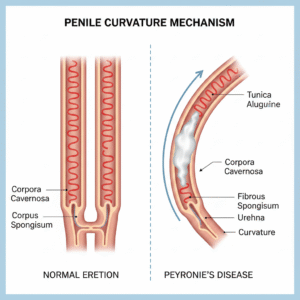
A curve in the penis during erection isn't automatically a medical problem — a mild curve is a normal anatomical variation for many men. But when the curve is significant, progressive, or painful, it's often Peyronie's disease: a treatable condition caused by scar tissue formation, not something you have to just manage quietly.
At Lumora Wellness in Dubai, Peyronie's disease is evaluated and treated by Dr. Vasan Satya Srini, an andrologist and urologist with over 30 years of experience diagnosing and treating exactly this kind of condition.
Andrologist& urologist-led care
DHACompliant, licensed supervision
100%Confidential consultations
This may be a medical emergency
If you experience a sudden popping sound during an erection, followed by swelling, bruising, or loss of erection, this may be a penile fracture — seek emergency medical care immediately. This is not treated on this page and requires urgent attention.
The basics
What Is Peyronie's Disease?
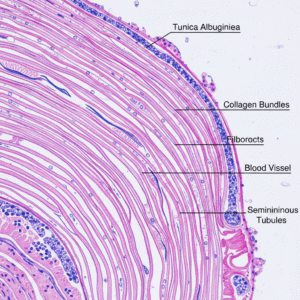
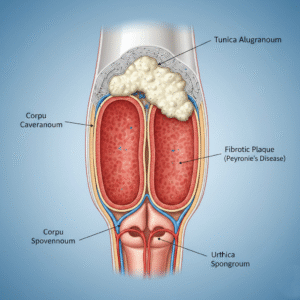
Peyronie's disease occurs when fibrous scar tissue (a "plaque") forms within the tunica albuginea — the fibrous sheath surrounding the erectile tissue of the penis. As the plaque forms, it restricts the tissue's ability to stretch evenly during an erection, causing the penis to bend or curve, often with pain.
It's estimated to affect a meaningful proportion of men, particularly those over 40, though many cases go undiscussed for years out of embarrassment.

Not all curvature is Peyronie's disease. A degree of curvature — roughly 5–30 degrees — is a normal anatomical variation and doesn't need treatment unless it's causing pain or interfering with intercourse. Peyronie's disease specifically involves an inflammatory process and plaque formation, usually following a change from previously straight erections.
Telling them apart
Peyronie's Disease vs. Congenital Penile Curvature
These two are frequently confused, but they're different conditions with different treatment paths.
Congenital (chordee)
Present from birth
Usually first noticed around puberty. There's no scar tissue or inflammatory process involved — it's simply how the erectile tissue developed.
Peyronie's disease
Develops later in life
Caused by scar tissue formation, often following an injury to the erect penis — though many men don't recall a specific traumatic event.

This drives everything
The Two Phases of Peyronie's Disease
Which phase you're in determines the entire treatment approach — which is why establishing it accurately comes before any treatment is recommended.
Phase one 5–18 months
Acute Phase
This is when the plaque is actively forming. Curvature typically worsens during this phase, and erections are often painful.
Treatment focus: non-surgical management to limit progression.
Phase two Stable
Chronic Phase
Once the scar tissue stops growing, curvature generally stabilizes and pain typically subsides — though erectile dysfunction can develop or worsen during this phase.
Treatment focus: most surgical decisions are made once this stable phase is reached.
Understanding the cause
What Causes Peyronie's Disease?
Microtrauma
Injury to the erect penis during intercourse or physical activity — leading to abnormal wound healing and collagen/plaque deposition.
Connective tissue disorders
May predispose some men to abnormal scarring.
Genetic predisposition
Peyronie's disease can run in families.
Aging
Most commonly diagnosed in men over 40, though it can occur at any adult age.
What to look for
Symptoms
- A noticeable curve or bend in the penis during erection
- A palpable lump or band of hard tissue (plaque) under the skin
- Pain during erection or intercourse, particularly during the acute phase
- Shortening of the penis
- Erectile dysfunction, particularly in the chronic phase
Step one
How Is It Diagnosed?
01
Detailed medical history, including onset, progression, and pain
02
Physical examination to locate and assess the plaque
03
In some cases, an injection to induce an erection in-clinic, allowing accurate measurement of curvature
04
Dynamic ultrasound, to assess plaque size, calcification, and blood flow where indicated
Your options
Treatment Options
Treatment follows the phase. Non-surgical management comes first during the acute phase to limit progression; surgical correction is considered once things have stabilized.

Non-surgical — acute / early phase
01
Traction therapy
Using a vacuum erection device or mechanical traction device to gently stretch the penis daily over several months, aiming to reduce curvature and preserve length.
02
Injection therapy
Medication (such as collagenase or interferon-based injections) delivered directly into the plaque to help break down scar tissue and reduce curvature and pain.
03
Oral and topical medication
Used in some cases as part of a broader management plan, though evidence for these varies and they're generally considered a supportive rather than primary treatment.
Surgical — stable / chronic phase
04
Plication
The tunica albuginea on the unaffected (opposite) side is shortened to straighten the curve. Best suited to men with good erectile function and less severe curvature.
05
Grafting
The plaque is removed or incised and replaced with a graft, allowing straightening with less risk of shortening; typically used for more severe curvature.
06
Penile implants
Recommended for men who have both Peyronie's disease and erectile dysfunction that hasn't responded to other treatments; straightens the curve and restores erectile function in a single procedure.
When performed by an experienced reconstructive specialist, surgical correction has reported success rates commonly cited in the 85–95% range for achieving a functional, satisfactory straightening. This is a general published range, not a prediction of your individual outcome — your specific outlook depends on plaque location, curvature severity, and erectile function, and is discussed in detail during consultation.
Surgery is generally considered once the condition has stabilized (no longer worsening) and is significantly affecting function or comfort.
The process
What to Expect: Your Treatment Journey
01
Consultation & assessment
History, physical examination, and determination of which phase you're in, since this drives the entire treatment approach.
02
Non-surgical management
Where appropriate — particularly if you're still in the acute phase, to limit progression before considering surgery.
03
Reassessment once stable
Curvature and symptoms are reviewed once the condition has plateaued.
04
Surgical correction if needed
Discussed in detail, including which technique is most suitable for your specific case and goals.

Meet your doctor
Dr. Vasan Satya Srini
MBBS, DNB (General Surgery), DNB (Urology/Genito-Urinary Surgery) — Andrologist
With over 30 years of experience and 100,000+ patients treated, Dr. Vasan is one of the most recognized names in Andrology and Men's Health in the region. He is the CEO and Medical Director of Ankur Healthcare Pvt. Ltd., past President of the South Asian Society for Sexual Medicine (SASSM), and has published 20+ research papers internationally.
30+Years in andrology
100,000+Patients treated
20+Research papers published

Why Lumora
Why Choose Lumora Wellness
Accurate phase assessment (acute vs. chronic) before recommending treatment — critical for choosing the right approach
Both non-surgical and surgical options available, tailored to your specific case
Care led by Dr. Vasan Satya Srini, a globally recognized andrologist and urologist
DHA-compliant treatment delivered under licensed medical supervision
Discreet, judgment-free consultations
DHA License No. 86633812-002
Lumora Wellness operates under Dubai Health Authority licensing. All treatments are delivered under licensed medical supervision.
Pricing
How Much Does Peyronie's Disease Treatment Cost in Dubai?
Cost depends on the stage of the condition and treatment approach — non-surgical management (traction or injection therapy) is typically an ongoing, lower-cost process over several months, while surgical correction is a one-time, higher cost that varies by technique (plication, grafting, or implant).
Book a consultation for an accurate quote based on your specific case.
Questions
Frequently Asked Questions
Is some penile curvature normal?
Yes. A degree of curvature — roughly 5 to 30 degrees — is a normal anatomical variation and doesn't require treatment unless it's causing pain or interfering with intercourse.
Will Peyronie's disease go away on its own?
Mild cases may stabilize without significant impact, but significant curvature rarely resolves completely without treatment. Early evaluation during the acute phase gives you the most treatment options.
Does Peyronie's disease affect fertility?
No, it does not affect sperm production. Fertility is generally only impacted if the curvature makes intercourse physically difficult or impossible.
Is surgery always necessary?
No. Many men are managed successfully with non-surgical treatment, particularly if caught during the acute phase. Surgery is generally reserved for stable, chronic cases causing significant functional or psychological impact.
How successful is surgical correction?
When performed by an experienced reconstructive specialist, surgical correction commonly achieves reported success rates in the 85–95% range for functional, satisfactory straightening — though your specific outlook depends on your individual case.
Can I still have sex during treatment?
This depends on your symptoms and treatment stage — your specialist will guide you on this directly, since pain and curvature severity vary significantly between men.
Is the consultation confidential?
Yes. Every consultation at Lumora Wellness is handled with complete discretion and confidentiality.
Ready to Have This Looked At?
The earlier Peyronie's disease is evaluated, the more treatment options are available to you. Book a confidential consultation and get a clear picture of what's happening and what to do next.
