


- Small Penis Treatment Dubai
- Longevity Health Check Dubai
- Male Genital Cosmetology Dubai
- Male Sexual Problems Treatment Dubai
- Prevention Health Check Dubai
- Premature Ejaculation Treatment in Dubai
- Erectile Dysfunction Treatment in Dubai
- Azoospermia (Zero Sperm Count) Treatment in Dubai
- Peyronie’s Disease Treatment in Dubai
- Reduced Penile Girth Treatment in Dubai



Male Fertility · Dubai
Azoospermia (Zero Sperm Count) Treatment in Dubai
Being told your semen analysis shows no sperm can feel like the end of the road — but for most men, it isn't. Azoospermia affects around 1% of all men and is found in up to 10–15% of men being investigated for infertility, and a large proportion of cases are treatable, or can be worked around using advanced sperm retrieval and fertility techniques.
At Lumora Wellness in Dubai, azoospermia is diagnosed and treated by Dr. Vasan Satya Srini — India's first qualified andrologist, a WHO consultant on male infertility, and a specialist with over 30 years of dedicated experience in exactly this condition.
Andrologist-ledNot a general urologist
WHO consultantOn male infertility
100%Confidential consultations
The basics
What Is Azoospermia?
Azoospermia means there is no measurable sperm in a man's ejaculate. It's diagnosed through semen analysis — typically confirmed across two separate samples — and is one of the most severe forms of male infertility.
Importantly, a diagnosis of azoospermia does not necessarily mean sperm production has stopped entirely; in many cases, sperm are still being produced but aren't reaching the ejaculate, which is exactly why identifying the type and cause matters so much.
The critical distinction
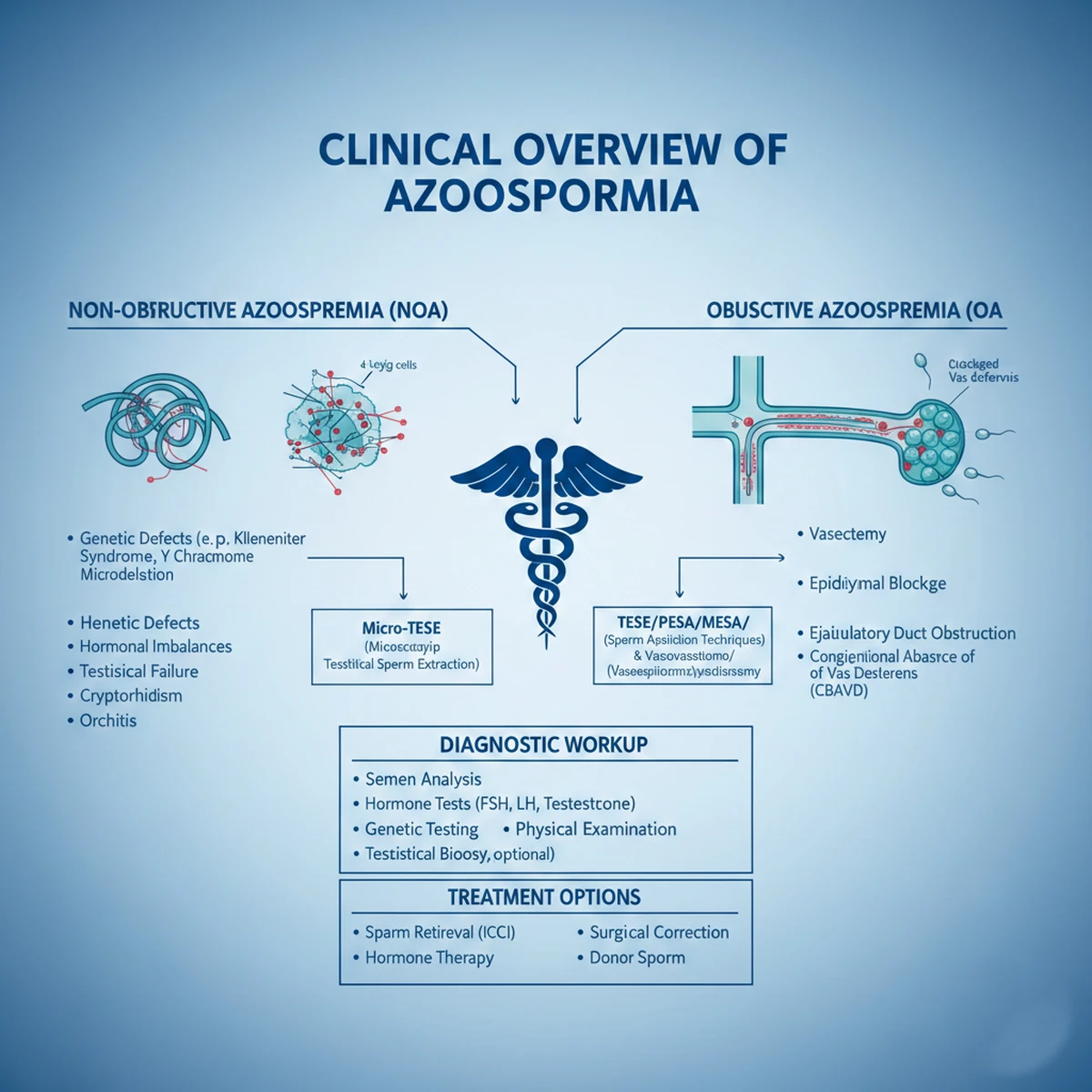
Types of Azoospermia
Almost everything about your treatment pathway follows from which of these two categories you fall into — which is why classifying it correctly comes before anything else.
OA
Obstructive Azoospermia
Sperm production is normal, but a physical blockage prevents sperm from reaching the ejaculate. Common causes include prior vasectomy, congenital absence of the vas deferens, infection-related scarring of the epididymis, or previous pelvic/groin surgery.
Generally the more treatable category — sperm exist, they simply need a way out, or a way to be retrieved.
NOA
Non-Obstructive Azoospermia
Sperm production itself is impaired or absent. Causes include genetic conditions (such as Klinefelter syndrome or Y-chromosome microdeletions), hormonal imbalance, undescended testicles, varicocele, prior chemotherapy or radiation, or, in many cases, no clearly identified cause (idiopathic NOA).
Requires a more involved diagnostic and treatment approach — and this is where technique choice matters most.
Understanding the cause
What Causes Azoospermia?
Identifying the underlying cause is what determines whether treatment aims to restore natural fertility, retrieve sperm directly, or both.
Genetic conditions
Including Klinefelter syndrome and Y-chromosome microdeletions.
Hormonal imbalance
Particularly low FSH/LH (hypogonadotropic hypogonadism), which impairs the signal to the testes to produce sperm.
Varicocele
Enlarged veins in the scrotum that can impair sperm production.
Prior surgery or vasectomy
Can create physical blockages along the reproductive tract.
Infection
Including untreated STIs or other infections causing scarring of the reproductive tract.
Undescended testicles
Cryptorchidism — especially if uncorrected in childhood.
Chemotherapy or radiation
Along with certain other medications that affect sperm production.
Congenital absence of the vas deferens
Often linked to a genetic carrier status for cystic fibrosis.
Step one
How Is Azoospermia Diagnosed?
A precise diagnosis is what determines whether treatment focuses on restoring natural fertility, retrieving sperm directly, or both. Evaluation at Lumora Wellness typically includes:
01
Repeat semen analysis to confirm the diagnosis
02
Hormonal blood panel (FSH, LH, testosterone, prolactin)
03
Physical examination, including testicular size and vas deferens assessment
04
Scrotal ultrasound to check for varicocele, obstruction, or structural abnormality
05
Genetic testing (karyotyping and Y-chromosome microdeletion testing) where indicated
06
In select cases, a diagnostic testicular biopsy to assess sperm production directly
Your options
Treatment Options for Azoospermia
Treatment follows the diagnosis: correct the underlying cause where that's realistic, clear an obstruction where one exists, or retrieve sperm directly where natural conception isn't possible.
01
Treating the Underlying Cause
Where azoospermia is caused by a hormonal imbalance, correcting it with hormonal therapy (such as gonadotropin therapy) can, in some men, restore natural sperm production over several months. Where a varicocele is the cause, surgical repair can improve sperm parameters, sometimes enough to conceive naturally or with less invasive fertility treatment.
02
Surgical Correction of Obstruction
For obstructive azoospermia caused by a prior vasectomy or a discrete blockage, microsurgical reconstruction (vasovasostomy or vasoepididymostomy) can restore sperm flow, in some cases achieving natural conception without needing IVF.
03
Four techniques, one right choice
Surgical Sperm Retrieval
When natural conception isn't possible, sperm can often still be retrieved directly and used with IVF/ICSI. The right technique depends on the type of azoospermia:
TESA / PESA
Needle aspiration
A less invasive option, generally used for obstructive azoospermia where sperm production is normal.
10–23%Retrieval in NOA
MESA
Microscopic epididymal sperm aspiration
A precise, microsurgical option particularly effective for obstructive azoospermia, associated with high sperm recovery and lower postoperative discomfort than testicular extraction.
HighRecovery in OA
TESE
Testicular sperm extraction
A small testicular biopsy to retrieve sperm directly from testicular tissue.
VariesBy individual case
Micro-TESE
Gold standard for NOA
Using an operating microscope, the surgeon identifies the testicular tubules most likely to contain sperm — meaningfully higher than blind extraction methods.
40–50%Retrieval in NOA
Figures shown are approximate published ranges for each technique in the stated category, not a prediction of your individual result. Your realistic chance of retrieval depends on your specific diagnosis and is discussed during consultation.
Any sperm retrieved can be used fresh or frozen for future IVF/ICSI cycles, in coordination with a fertility/IVF partner.
The process
What to Expect: Your Treatment Journey
01
Diagnostic consultation
History, semen analysis review, and hormonal workup to classify obstructive vs. non-obstructive azoospermia.
02
Targeted testing
Imaging and, where relevant, genetic testing to pinpoint the underlying cause.
03
Treatment plan
Corrective treatment where restoring natural fertility is realistic, or a sperm retrieval pathway where it isn't.
04
Coordination with fertility partners
Where retrieved sperm will be used for IVF/ICSI, we coordinate closely with your fertility clinic for timing and sample handling.

Meet your doctor
Dr. Vasan Satya Srini
MBBS, DNB (General Surgery), DNB (Urology/Genito-Urinary Surgery) — India's First Qualified Andrologist
With over 30 years of experience and 100,000+ patients treated, Dr. Vasan is internationally recognized for his contributions to male infertility. He is a former Trustee of the International Continence Society (ICS, UK), a member of WHO consultations on male infertility and incontinence, Founder Secretary of the South Asian Society for Sexual Medicine (SASSM), and has received multiple awards for innovation in andrology. He established India's first dedicated Andrology & Men's Health Centre.
30+Years in andrology
100,000+Patients treated
WHOConsultant on male infertility
Why Lumora
Why Choose Lumora Wellness
Diagnosis and treatment led by a specialist andrologist, not a general urologist — the distinction matters significantly for male infertility outcomes
A precise diagnostic approach that identifies the actual cause before recommending treatment
Access to advanced sperm retrieval techniques and coordination with fertility/IVF partners
DHA-compliant treatment delivered under licensed medical supervision
Discreet, judgment-free consultations for what is often a deeply personal diagnosis
DHA License No. 86633812-002
Lumora Wellness operates under Dubai Health Authority licensing. All treatments are delivered under licensed medical supervision.
Pricing
How Much Does Azoospermia Treatment Cost in Dubai?
Cost depends heavily on the diagnostic pathway and treatment required — hormonal therapy and diagnostic workup sit at one end, while surgical sperm retrieval procedures (which involve theatre time, anesthesia, and embryology support) cost considerably more, and any subsequent IVF/ICSI cycle is a separate cost through your fertility partner.
Book a consultation for a clear breakdown based on your specific diagnosis.
Questions
Frequently Asked Questions
Does azoospermia mean I can never have biological children?
Not necessarily. Many men with azoospermia are still producing sperm — it just isn't reaching the ejaculate — and can father biological children through surgical sperm retrieval combined with IVF/ICSI, or in some cases through surgical correction of the underlying cause.
What's the difference between obstructive and non-obstructive azoospermia?
Obstructive azoospermia means sperm production is normal but blocked from reaching the ejaculate — generally more treatable. Non-obstructive azoospermia means sperm production itself is impaired, which requires a different, more involved diagnostic and treatment approach.
How is azoospermia diagnosed?
Diagnosis typically involves at least two semen analyses to confirm the finding, a hormonal blood panel, physical examination, and often a scrotal ultrasound. Genetic testing or a diagnostic biopsy may follow depending on the initial results.
What is Micro-TESE and why is it considered the gold standard?
Micro-TESE (microdissection testicular sperm extraction) uses an operating microscope to identify testicular tubules most likely to contain sperm, rather than blindly sampling tissue. This significantly improves sperm retrieval rates in non-obstructive azoospermia compared with older techniques like TESA.
Is azoospermia genetic?
It can be. Conditions such as Klinefelter syndrome and Y-chromosome microdeletions are known genetic causes, which is why genetic testing is often part of a thorough diagnostic workup, particularly for non-obstructive azoospermia.
If sperm is retrieved, do I need IVF?
Yes — sperm retrieved surgically (via TESA, MESA, TESE, or Micro-TESE) is used with ICSI, a specialized form of IVF where a single sperm is injected directly into an egg, since surgically retrieved sperm generally cannot fertilize an egg through conventional IVF.
Can azoospermia be prevented?
Some causes (such as genetic conditions) can't be prevented, but others — including infection-related and lifestyle-related causes — may be reduced through prompt treatment of infections, avoiding prolonged heat exposure to the testicles, and general reproductive health awareness from a younger age.
Is the consultation confidential?
Yes. A fertility diagnosis is deeply personal, and every consultation at Lumora Wellness is handled with full discretion and confidentiality.
Ready to Get a Clear Diagnosis?
A zero sperm count result raises more questions than it answers on its own. Book a confidential consultation with Dr. Vasan's team to understand exactly what's happening and what your realistic options are.
